Guides
Payroll tax on a taproom wage: employer rates and penalties
Payroll tax on a taproom wage: employer FICA and FUTA rates, a Texas hire worked through, and the IRS late-deposit penalty ladder from 2% to 15%.
What to take away
- Payroll tax cost has three parts to plan forthe employer taxes on top of wages, the fee to run the process, and the penalty for missing a deposit deadline.
- Employer taxes are 6.2 percent Social Security, 1.45 percent Medicare, and 6.0 percent FUTA on the first $7,000, then a state unemployment rate assigned to you.
- Processing is the smallest part. Software, a bureau and a CPA differ in who watches the deposit calendar.
- Late deposits of withheld money are the expensive failure. Penalties arrive quickly and can reach owners personally.
- Budget from a total employment cost figure for one hire, one wage and one state.
Employer taxes that sit on top of the wage
An hourly wage is not the cost of an hour of work. Employers pay their own Social Security and Medicare tax, federal unemployment tax and a state rate assigned to them.
Employer Social Security is 6.2 percent of wages up to an annual wage base, and Medicare adds 1.45 percent with no cap. Employees have the same amounts withheld, so every hire carries two layers of the same tax.
Federal unemployment tax is 6.0 percent on the first $7,000 of each worker's wages. A credit of up to 5.4 percent for state tax paid on time cuts that to 0.6 percent, or $42 per worker per year.
State unemployment tax has no national number. Your rate follows your claims history and arrives in an annual notice from the state agency that administers it — the Texas Workforce Commission, for a Texas taproom. A new employer starts on a state-assigned rate until its own claims history takes over, and both the rate and the wage base are set by the state, not by the IRS.
Tips count as wages for payroll tax. A tip credit lets the cash wage sit below the minimum while cash plus tips reaches the federal floor, and the employer still owes its own share on reported tips.
The conditions in 29 CFR part 531 set out what qualifies. Because the pool decides who receives what, set up taproom tip pooling within FLSA rules before the first pay period runs.
Example: total employment cost for a taproom hire
Take a taproom hire in Texas at $18 an hour, 32 hours a week, all year. Gross wages are $29,952.
Employer Social Security and Medicare at 7.65 percent add about $2,291. Federal unemployment tax adds $42, since only the first $7,000 of wages is taxed.
Federal employer tax comes to about $2,333, or 7.8 percent of wages. At 40 hours a week the same rate pays $37,440, with roughly $2,906 in federal employer tax.
That stops at the federal line. State unemployment tax billed by the Texas Workforce Commission, workers' compensation, paid leave and benefits sit on top. Have your accountant price one named hire in your state before you make the offer.
Payroll software, service bureaus and CPA firms: what you still own
Payroll runs three ways, and each is priced differently. Ask what a vendor charges for the first worker and for the tenth, and who files the returns.
Payroll routes compared
How it is priced
- Spreadsheet
- Your time
- Payroll software (Gusto, QuickBooks Payroll, Square Payroll)
- Per worker, per month
- Service bureau (ADP, Paychex)
- Higher per worker, often a monthly minimum
- CPA or accounting firm
- Monthly retainer, plus returns
What you still own
- Spreadsheet
- Every deadline and every annual rate change
- Payroll software (Gusto, QuickBooks Payroll, Square Payroll)
- The liability, even when filing is automated
- Service bureau (ADP, Paychex)
- More of the calendar handled, plus a support line
- CPA or accounting firm
- Judgment on classification and new-state registration
List prices change and scale with headcount, so ask for a written quote at your own numbers. The bookkeeping habits that catch payroll drift give you a place to file it.
Five questions to ask a payroll provider
Ask every provider the same five questions and write the answers down.
Questions to ask a provider
- Who files the federal, state and local returns, and is that covered by the fee?
- Who pays the penalty if a deposit is late because of your filing?
- What changes in fees and registrations when I add a second state?
- How do you handle reported tips, tip credit and tip pools?
- What is the notice period, the final fee, and how do I get my data out?
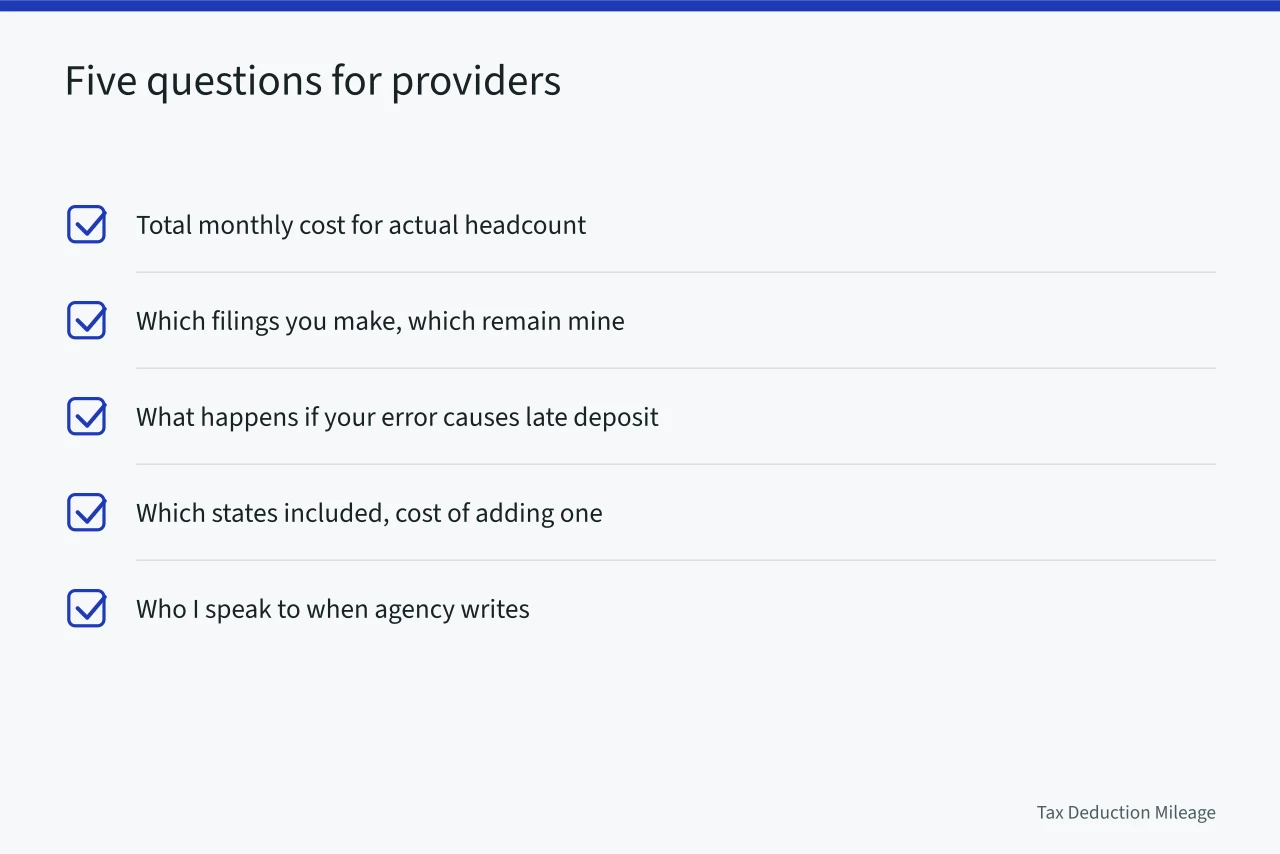
Question three separates a processor from a service. Question five is the one you will regret skipping.
Penalties, deposit schedules and late deposits
Withheld income tax and the employee's FICA share are held in trust. Miss a deposit deadline and the money becomes a trust fund recovery issue that can reach responsible individuals; the IRS assesses that personal liability under IRC §6672.
The IRS sets deposit schedules and penalty categories for monthly and semiweekly depositors, and the failure-to-deposit penalty itself is graded by how late the payment is under IRC §6656. The schedule follows the liability reported in a lookback period.
Employers report the withheld income tax and the employee's FICA share on IRS Form 941 each quarter. Federal unemployment tax is reported once a year on Form 940, and a small employer with low annual liability files Form 944 annually instead. Most new employers deposit monthly for their first year; once liability in the lookback period passes the IRS threshold, the schedule moves to semiweekly, and a large one-day liability is due the next business day.
The failure-to-deposit penalty is a percentage of the taxes not deposited on time, in the right amount or in the right way, and it rises with the number of calendar days the deposit is late. The IRS failure to deposit penalty ladder is 2% of the unpaid deposit for 1 to 5 calendar days late, 5% for 6 to 15 days, 10% for more than 15 days, and 15% when the deposit is still unpaid more than 10 days after the first notice or letter. The steps do not add up: a deposit more than 15 days late carries 10% in total, not 2% plus 5% plus 10%. Interest is charged on penalties as well.
Failure to deposit, failure to file and failure to pay are calculated separately, and the amounts change. Timing slips are the common thread in the payroll mistakes that trigger a DOL audit.
If cash is tight, the withheld money is the last payment to delay. It is not the business's money.
Canadian source deductions on taproom payroll
Canadian taprooms withhold CPP, EI and income tax as source deductions. The employer matches CPP and pays EI at a multiple of the employee rate. The CRA's payroll guidance for businesses covers calculation and remittance.
Both shares leave the account on the same remittance date, so the employer portion is a cash-flow item as much as a cost. Remittance frequency follows your average monthly withholding, so growth can move a taproom to a faster schedule mid-year.
Common questions
What percentage should I add on top of wages?
Start with 7.65 percent for the employer FICA share, plus 0.6 percent on the first $7,000 of wages for FUTA. Then add the state unemployment rate from your notice.
Is it cheaper to run payroll in-house than to outsource it?
In fees, yes. In risk and attention, usually not, and the gap widens with every state you add.
What does payroll software or a payroll service cost?
Pricing is usually per worker per month, sometimes with a monthly minimum, and list prices move. Ask for a written quote at your headcount.
Do the payroll tax rules differ in Canada?
Yes. Employers withhold CPP, EI and income tax and remit on a schedule set by average monthly withholding. This guide to Canadian tip withholding and source deductions covers how tips are treated.