
Guides
Payroll tax for employers: components, forms and liability
Payroll tax for employers: the FICA rates and wage base, the federal forms and deposit schedules, and the trust fund penalty that makes it personal.
Start with the sentence that explains everything else on this page: most of the money in a payroll tax account was never yours.
When you withhold tax from an employee's pay, you are holding their money on the government's behalf until you hand it over. That is a different kind of obligation from owing your own tax, and the system treats it differently: more urgently, less forgivingly, and with consequences that can reach past your business and land on you personally.
What to take away
- Payroll tax is several separate obligations running at oncewithheld employee tax, the employer's own share, unemployment taxes, and whatever your states add.
- Deposits run on a schedule assigned to you. It is not a preference and it does not wait for your cash flow.
- Individuals responsible for withheld tax can be held personally liable for it. Operating through an entity does not necessarily protect you here.
- Whether a worker is an employee or a contractor is not a matter of what you both agreed to call it.
- Get this set up with a professional before the first payment, not after the first notice.
The moving parts
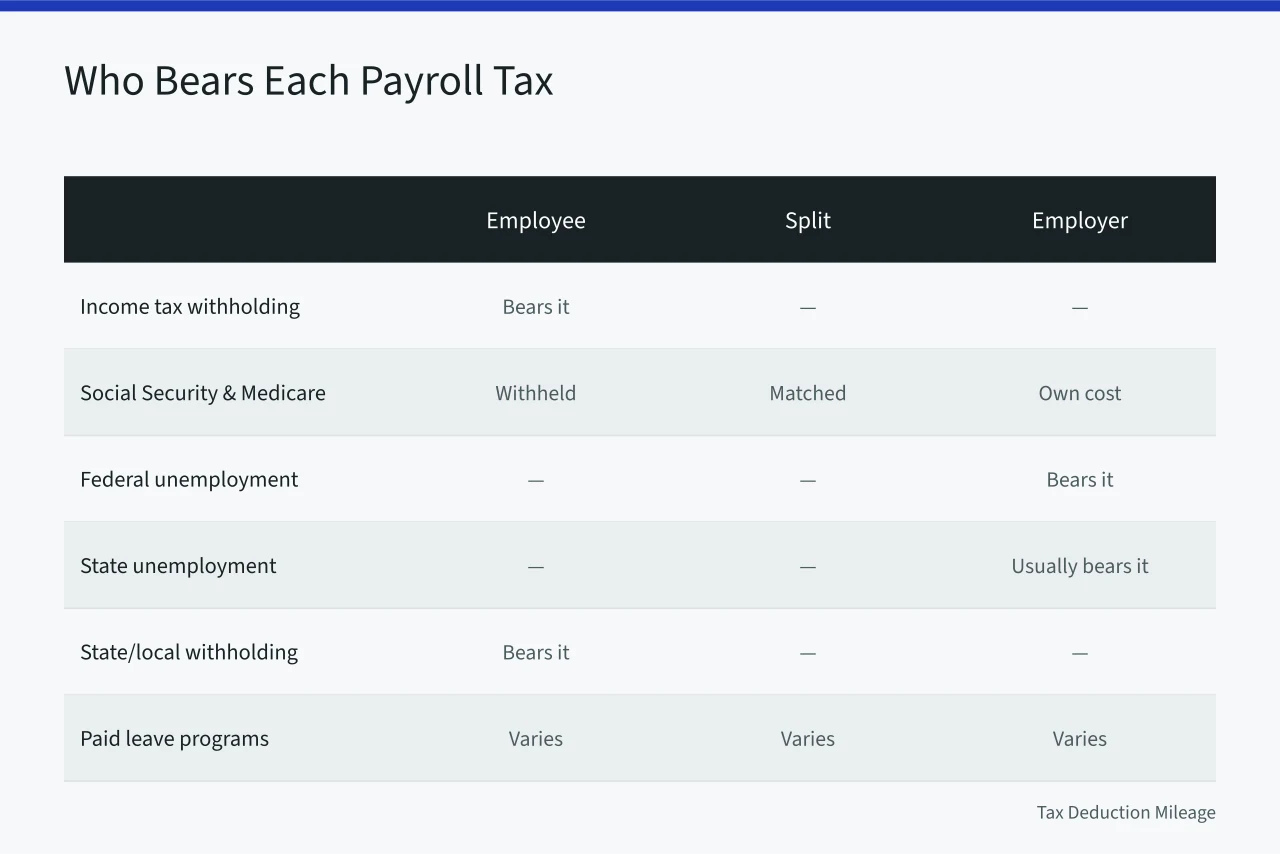
| Component | Who bears it | What it is |
|---|---|---|
| Income tax withholding | The employee | Their tax, withheld by you from their pay and paid over on their behalf |
| Social Security and Medicare | Split between employee and employer | Withheld from the employee, matched by the business as its own cost |
| Federal unemployment tax | The employer | An employer-level tax, not withheld from anyone |
| State unemployment insurance | Usually the employer | Rates and rules set by each state, often experience-based |
| State and local withholding | The employee | Where the state or locality imposes income tax |
| Paid leave and other state programs | Varies | Several states run additional programs with their own contributions |
The federal Social Security and Medicare layer comes from the Federal Insurance Contributions Act (FICA). The employee's share of the Social Security portion of the FICA tax is 6.2% of gross compensation up to a limit that adjusts each year, the Social Security Wage Base, and the employee's share of Medicare is 1.45% of wages, with no limit on the wages subject to it. The employer is also liable for 6.2% Social Security and 1.45% Medicare, making the total Social Security tax 12.4% of wages and the total Medicare tax 2.9%. Check the current year's wage base in Publication 15 before you budget.
Two of these are your business's own expense; the rest is other people's money passing through your account. It is worth knowing which is which, because your instinct in a tight month will be to treat the balance as one pot, and that instinct is precisely the one that gets owners into trouble.
Why payroll is the least forgiving area of tax
Three features combine to make this different from the rest of your tax life.
It is trust money. Amounts withheld from workers are held for the government. Spending them on payroll for the following week, or on rent, is not a cash-flow decision; it is using funds that were collected on someone else's behalf.
Responsibility can be personal. Where withheld tax is not paid over, individuals who were responsible for collecting and paying it can be pursued personally for it. That can include owners, officers, and in some circumstances people who simply had authority over which bills got paid. The limited liability that protects you from ordinary business debts does not reliably extend here. If you take one thing from this page, take that.
The mechanism has a name: the Trust Fund Recovery Penalty (TFRP), under section 6672 of the Internal Revenue Code. The IRS manual describes it as a penalty against any responsible person required to collect, account for, and pay over taxes held in trust who willfully fails to perform any of these activities. It equals the total amount of tax not collected or not accounted for and paid over, and it applies to the employees' portion: the withheld income tax and the employee's share of FICA, not the employer's share.
The clock is short and it repeats. Deposits are due on a schedule assigned to you based on the size of your payroll history, not on your preference. Missing one is not a small slip; consequences generally increase the longer it goes unfixed, and the cycle comes round again before you have caught up.
The upshot: payroll is the last obligation to defer and the first to automate. Owners who juggle everything else successfully still get destroyed by this one, because it is the only area where being three weeks late compounds into something personal.
The question that comes before payroll: who is an employee?
You cannot decide this by agreement, preference, or a document labeled independent contractor. The substance of the relationship controls.
Look at how much control the business has over what is done and how, the worker's financial independence, and how outsiders see the relationship.
Getting it wrong is expensive in a specific way: the amounts you should have withheld and matched do not stop being owed because you did not withhold them, and the assessment lands on the business rather than the worker.
Practical guidance:
- Decide it before the first payment, and document how you decided.
- Be honest about control. If you set the hours, direct the method, provide the tools, and the person works only for you, calling them a contractor does not make them one.
- Treat similar workers consistently. Inconsistency is what draws attention.
- If it is genuinely unclear, you can ask the IRS to make a determination, and there are relief provisions in some circumstances. Ask your accountant which route fits before you rely on either.
- Paying contractors brings its own reporting obligationsinformation returns above certain thresholds, chiefly Form 1099-NEC for nonemployee compensation. The threshold changed for payments made in 2026, so confirm the current threshold in Publication 15 rather than assuming.
Before the first payroll runs
The setup work is unglamorous and every item on it is a prerequisite rather than a nicety.
- Federal employer identification, if you do not already have it.
- Registration with each state where you will have employeestypically both for income tax withholding and for unemployment insurance, which are often separate registrations with separate agencies.
- New hire reporting, which most states require within a short window of hiring.
- Collected withholding elections from each employee, and eligibility verification.
- A decision on pay frequency that complies with your state's rules, which can be stricter than you expect.
- A payroll system, or a provider, chosen before the first pay run rather than during it.
- Workers' compensation coverage where required, not a tax, but it belongs on the same checklist because it is the other thing people discover late.
Adding your first employee is one of the moments where your whole tax picture shifts. It is worth an hour with your accountant, and it may also be worth revisiting how the business is taxed at the same time: see entity tax treatment.
The recurring cycle
Once running, payroll settles into a rhythm with three layers.
Each pay run: calculate gross pay, withhold correctly, apply the employer's own share, and record it all properly. Non-cash compensation and benefits are part of this too, things given to employees are generally taxable unless a specific rule excludes them, and this is a common source of quiet error.
On your deposit schedule: pay the withheld and employer amounts across electronically. Know your assigned frequency and know that it can be reassigned as your payroll grows. IRS Publication 15 (Circular E), the Employer's Tax Guide, sets out two deposit schedules, monthly and semiweekly, for social security, Medicare and withheld federal income taxes, and which one applies is fixed by a lookback period that begins July 1 and ends June 30.
The returns by name: Form 941, the Employer's Quarterly Federal Tax Return, reports withheld income tax and FICA each quarter. The federal unemployment tax is reported on Form 940, filed annually. Each employee gets a Form W-2 showing the wages paid and the federal, state and local taxes withheld.
Periodically and at year end: file the payroll returns on their own cycle, reconcile what you withheld against what you deposited, and issue each worker the statement they need to file their own return. Those worker statements are due early in the year, typically before your own business return, and they are due whether or not your books are finished. The wider calendar is in tax deadlines.
Reimbursing employees for expenses sits alongside this. Handled through a properly constituted arrangement, a reimbursement is not pay. Handled casually, it can become taxable compensation, which is an expensive way to buy someone a tank of fuel. If you reimburse business driving, that arrangement and the substantiation behind it matter: see mileage rates.
Remote workers and more than one state
The federal layer is the same everywhere. The state layer is not, and it is where a growing business quietly accumulates obligations.
Broadly, where an employee physically works drives which state's withholding and unemployment rules apply: with exceptions, reciprocity arrangements between certain states, and special cases that make "broadly" carry real weight. One employee working from another state can require you to register there, withhold there, and file there.
Two habits keep this manageable. Ask where a new hire will actually be working before you agree to the arrangement, not after. And treat an existing employee's move as a payroll event, because it is one.
If you use a payroll provider
Most small employers should. It is one of the few compliance costs that is straightforwardly worth paying, because the software knows the deposit schedules and the filing cycles and you will not.
But understand what you have and have not outsourced. Using a provider does not transfer the legal responsibility for the deposits and filings. If the money does not reach the government, the exposure is still yours.
So: confirm that deposits are actually being made rather than assuming, keep your own access to the accounts, and read the notices that arrive rather than forwarding them unopened. A provider failing quietly is rare and catastrophic, and the only thing standing between you and it is somebody checking.
Paying yourself
If your business is taxed so an owner who works in it must be on payroll, that is an obligation, not an option. It comes with the expectation that pay is reasonable for the work performed.
Setting it too low to reduce the employment-tax layer is a well-known position and a well-known area of challenge.
If your business is taxed in a way that does not use payroll for owners, taking money out is generally a draw rather than a wage, and paying yourself through payroll anyway creates a mess. Which of these applies to you follows from your classification, so confirm the classification first.
If you are already behind
Do not wait, and do not prioritize the friendliest creditor. Payroll obligations should generally be near the front of the queue precisely because of the personal exposure attached to them.
File the returns even if you cannot pay everything, because filing and paying are separate failures with separate consequences, and going quiet is the worst available option. Then get a professional involved immediately.
There are payment arrangements and situations where the right sequence of steps materially reduces the damage. This is the clearest case on the whole site for paying someone who does this every day.
Where to check
| Source | Use it for |
|---|---|
| IRS employment tax pages | Deposit schedules, filing cycles, and current federal requirements |
| IRS Publication 334, Tax Guide for Small Business | Plain-language orientation for small business obligations |
| Your state's revenue and unemployment agencies | Registration, withholding, unemployment rates, and state programs |
| A licensed CPA, enrolled agent, or payroll specialist | Setup, classification questions, and anything already behind |
Start with the small business tax guide before accepting anyone's summary, this page included, and check the year printed on it.
For payroll specifically, the IRS's employment taxes pages are the direct source. Your state agencies are the only authority on their own layer, and what the business can deduct for the wages it pays is in business deductions. The second agency in each state is covered in state business tax.
Ask your accountant
- What is my deposit schedule, and what would change it?
- Are my workers classified correctly, and what would you want to see if that were questioned?
- Which states am I registered in, and does where my people work match that list?
- If I am required to take a salary, is what I am paying myself defensible?
- If I fell behind, what should I do in the first week?
Common questions
Are payroll taxes deductible for the business?
The employer's own share is generally a business expense. Amounts withheld from employees are part of their wages, not an extra cost to you. Confirm the treatment for your specific items with your preparer.
Can I pay someone as a contractor to keep it simple?
Only if the relationship genuinely is a contractor relationship. Simplicity is not a factor in the test, and the reassessment lands on the business.
My payroll provider handles everything. Am I covered?
Operationally, largely. Legally, the responsibility remains yours. Verify the deposits are being made and read the notices.
What if I withheld correctly but could not afford to deposit?
Act immediately and get professional help the same week. Withheld amounts are the highest-risk category of tax debt there is because of the personal exposure attached, and the situation deteriorates with time rather than stabilizing.
Do I have to run payroll to pay myself?
It depends entirely on how your business is taxed. Some classifications require it for owners who work in the business; others do not use it for owners at all. Confirm your classification before setting anything up.