Guides
Brewery and taproom inventory planning: reorder points
Brewery and taproom inventory planning: set reorder points from usage and lead time, buffer for variability, and account for freshness and storage limits.
What to take away
- For brewery and taproom inventory planning, the answer is a reorder point per item, not a target stock level. Stock levels go stale; reorder points keep working as demand moves.
- Every item needs four inputsaverage usage, lead time, variability in both, and the cost of a stockout.
- Finished beer is the exception. It is limited by a freshness clock and by cold storage volume, so holding more is not automatically safer.
- Cover the longest lead time in your chain, which is usually artwork or a specialty ingredient rather than the brewing itself.
- Recalculate after any change in hours, tap list or supplier. A reorder point set last year describes last year's business.
Four inputs, per item
Work these out for each thing you buy. Do it in your own units and write the date beside each number, because they drift.
Reorder point formula
- Cycle stock = D times T
- Safety stock covers Vd and Vt
- Safety stock set by stockout cost
- Reorder point = cycle stock + safety stock
- Hit it, then order
Four numbers per item
- Daverage usage per week
- Tlead time in weeks
- Vdusage variability range
- Vtlead time variability
- D
- is average usage per week, taken from your own records over a period long enough to include a slow week and a busy one.
- T
- is the lead time in weeks, from placing the order to being able to use it. Ask the supplier and then check it against what actually happened.
- Vd
- is how much D varies. Not a formal statistic, just the range between your quietest and busiest weeks.
- Vt
- is how much T varies. A supplier who is sometimes two weeks and sometimes five is a different problem from one who is always four.
Then:
Cycle stock = D times T. This is what you consume while waiting for the order to arrive.
Safety stock covers the variability. Set it against Vd and Vt together, and against what a stockout costs. An item that stops a brew day gets generous safety stock. An item you can substitute gets very little.
Reorder point = cycle stock plus safety stock. When you hit it, you order. Not when the shelf looks low, and not on a monthly rhythm.
Cycle stock is the mechanical part; setting safety stock requires judgment, based on what a stockout costs rather than what the item costs.
For a simple historical buffer, record usage from order placement until each past order was usable. Safety stock = max(0, highest observed usage during a replenishment lead time − (average weekly usage × average lead time)). This uses the highest observed cycle as a buffer, not a statistical service-level target; recalculate it when demand or suppliers change.
The reorder point answers when to order, not how much. If you buy on scheduled reviews, set an order-up-to level to cover expected use through the next review plus supplier lead time and safety stock, then subtract usable on-hand stock and confirmed incoming orders; cap the purchase by supplier minimums, storage capacity, and freshness.
Cost of a stockout, by category
Rank your items by this rather than by spend. The two rankings look nothing alike.
Stockout cost by category
Category
- Yeast
- Stops schedule
- Gas
- Stops service
- Base malt
- Beer unbrewable
- Chemicals
- Safety compromised
- Specialty
- Recipe changes
- Packaging
- Run stops
- Glassware
- Service degrades
- Merch
- Lost sale
Stockout effect
- Yeast
- Generous
- Gas
- Generous
- Base malt
- Generous
- Chemicals
- Generous
- Specialty
- Moderate
- Packaging
- Moderate
- Glassware
- Modest
- Merch
- Minimal
Safety stock
- Yeast
- Gas
- Base malt
- Chemicals
- Specialty
- Packaging
- Glassware
- Merch
| Category | What a stockout does | Safety stock posture |
|---|---|---|
| Yeast | Stops the schedule entirely | Generous, plus a named backup source |
| Gas | Stops service the same day | Generous, always a spare cylinder |
| Base malt | A core beer cannot be brewed | Generous, and contracted where possible |
| Cleaning chemicals | Safety and quality both compromised | Generous, they are cheap |
| Specialty malt and hops | A recipe changes or is dropped | Moderate, substitution is often possible |
| Packaging materials | A run cannot happen | Moderate, but watch the approval clock |
| Glassware | Service degrades slowly | Modest |
| Merchandise | A lost sale, nothing more | Minimal |
Notice that the top of the table is mostly cheap items. That is the point. The cost of holding an extra cylinder of gas is trivial next to the cost of a Saturday with no service.
Finished beer is different
Everything above assumes that holding more is safer. For finished beer it is not, because of the third clock: beer has a freshness window and it is running while the stock sits.
Finished beer planning inputs
- Weekly depletion by beer from POS
- Interval between packaging runs
- Cold storage volume, a fixed limit
- Cover longest gap plus busiest week
- No more, or beer pours past best
So the question for finished beer is not how much to hold but how much depletion your cold storage and your freshness window can cover. Work out:
- Weekly depletion by beer, from your point of sale.
- The interval between packaging runs for that beer.
- Your cold storage volume, which is a fixed physical limit set by the building.
You want enough to cover the longest realistic gap between runs plus the variability of your busiest week, and no more. Holding more than that means pouring beer past its best, which is a quality problem that arrives quietly.
If cold storage is your binding constraint rather than the freshness clock, that is a building fact rather than a planning one, and it belongs with the physical constraints described in how sourcing and inventory planning works.
The lead time that actually binds
Ask which item in your chain has the longest lead time, and be prepared to be surprised. It is frequently not an ingredient.
Label approval is the long clock
- Firstartwork drafted
- Thensubmitted for approval
- Thenregulator review, no compression
- Thencleared, beer can be sold
- Plan backwardfrom this clock
Label artwork and its approval process often form the longest single clock in a packaged product. A supplier cannot compress it, and neither can you, because it sits with a regulator.
Start from the Alcohol and Tobacco Tax and Trade Bureau: Starting a TTB-Regulated Business: Brewery page for the framework of a brewer's obligations. For a packaged beer that requires federal label approval, the applicable route is TTB's Certificate of Label Approval (COLA) process; its application is the TTB F 5100.31 form, titled “Certificate/Exemption of Label/Bottle Approval.” Confirm whether approval applies and ask TTB about the process and timing for the specific product.
Plan backward from the binding clock rather than from the release date. A seasonal beer whose label has not been cleared is not a scheduling problem, it is a beer you cannot sell.
Demand is not a constant
Your D is an average and averages hide the thing that matters, which is when demand is going to move.
Adjust D or safety stock?
Is the demand mover known in advance?
adjust D, not safety stock
safety stock absorbs it
Three predictable movers in this trade: seasonality, event weekends, and any change to your own hours. All three are things you know about in advance, and all three should be applied to D as an adjustment rather than absorbed by safety stock. Safety stock is for surprises, not for the festival you have known about since March.
Since promotions and events are the largest short term movers, plan the stock alongside the promotion rather than after it. That connection is one reason filling the hours you already staff is an operations question as much as a marketing one.
Storage, handling and the rules around it
Holding stock has obligations attached to it, not just costs.
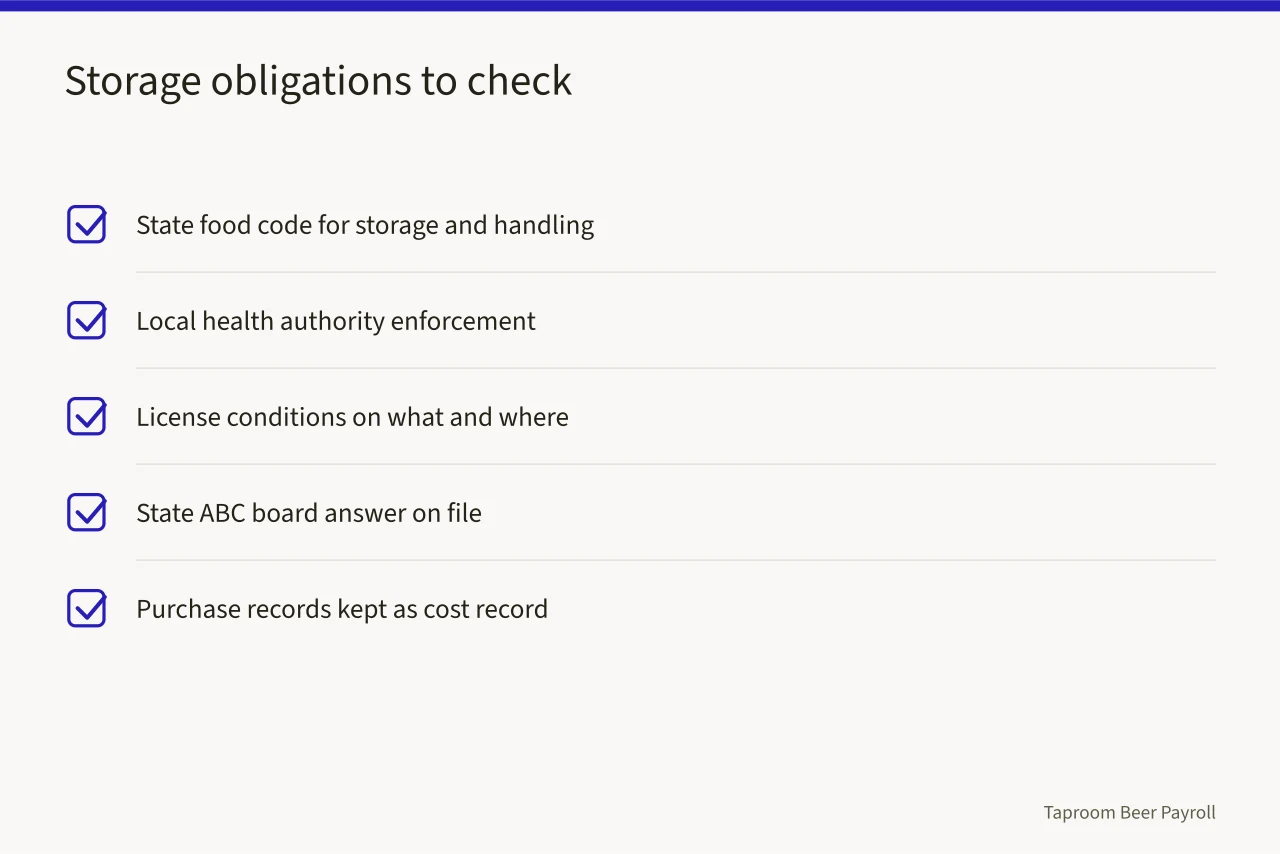
Where you serve food, the storage and handling requirements come from whichever code your state has adopted, identified on the U.S. Food and Drug Administration: State Retail and Food Service Codes and Regulations page and enforced by your local health authority. That affects how things are stored, separated and dated in the same cooler your beer lives in.
Your license may also carry conditions about what may be stored where and in what quantity, so ask your state alcohol beverage control board and keep the answer with the rest of what your license actually requires of you.
The purchase records supporting all of this are part of your cost record. The Internal Revenue Service: What kind of records should I keep? guidance is that the system is yours to choose provided it clearly shows income and expenses and the supporting documents survive.
The cost of holding, honestly
Stock is cash you have spent and cannot use. In this trade it is also space, and space is usually the tighter constraint.
Count all four costs when you set safety stock: cash tied up, storage space, aging risk, and handling time. The last is real but rarely counted.
Someone must move, rotate, and count everything you hold. That paid time belongs with the rest of hiring and training the crew.
Then set the level and stop debating it weekly. The value of a reorder point is that it removes a recurring decision.
When to recalculate
- After any change to opening hours, because D moves.
- After a change of supplier, because T and Vt move.
- After a change to the tap list or the packaged range.
- Once a season, as a habit.
- Before any step in the routes to more volume, since every one of them changes both the usage and the storage picture.
Write the date on the calculation. A reorder point with no date on it will be trusted long after it stopped being true.
Common questions
How many kegs should I keep in the cooler?
Enough to cover the longest realistic gap between packaging runs plus your busiest week's variability, capped by your cold storage volume and by the freshness window. Derive it from your own depletion rather than from a number of kegs.
Should I buy malt in bulk to save money?
Only if you have dry storage that keeps it in condition and the usage to get through it before quality suffers. A discount on stock that degrades is not a discount.
What is a reasonable safety stock level?
There is no general figure, because it depends entirely on what a stockout of that item costs you. Rank by consequence, be generous at the top of that ranking and thin at the bottom.
How do I handle a supplier with unpredictable lead times?
Raise safety stock for that item and find a named alternative you have actually spoken to. Then decide whether the unpredictability is worth the price difference.
Does a seasonal beer need its own calculation?
Yes, and start from the binding lead time, which is often the label or a specialty ingredient. Work backward from that rather than from when you want it on tap.